
After years of playing hobby board games and spending time in board game communities, I’ve noticed there are some common issues that can arise among gaming groups. With this zine, I wanted to briefly address one of these issues and share some useful mental health information to boot.
What I quickly found was that an eight-page micro-zine fills up in no time at all! So in addition to sharing the zine itself, here I’d like to expand just a little on its content, adding more context that I was unable to legibly cram in.
If you’d like to download the zine yourself, you can get it here:
Page 3: What’s Happening?
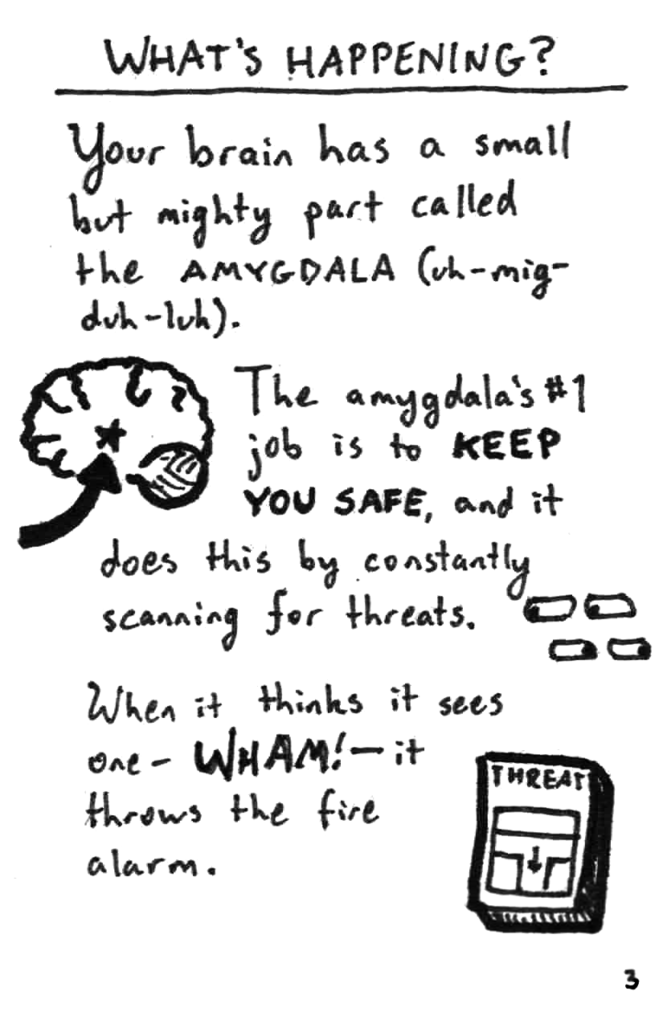
Ah, the amygdala. If you only ever learn about one part of your brain, my vote is for the amygdala. Understanding the amygdala will help you understand your snap reactions.
The amygdala acts as something akin to the “security hub” in your brain. Information from all your senses goes through your amygdala, where it constantly evaluates the data to look for potential threats.
The key word here is potential. The amygdala evolved to keep us safe and alive, which means that it evolved to prioritize jumpiness over accuracy. Think about it: who’s more likely to be eaten, the animal with a shy, slow, or chilled-out amygdala, or the hyper-alert one? Hyper-alert lives to see another day, again and again. Our amygdalas today have been shaped by eons of jumpiness being paid off. Your amygdala doesn’t care about being right, just safe, so it will leap at perceived threats.
And what’s “throwing the fire alarm”? That refers to launching your acute threat response, also known as “fight-or-flight” (or, if you want to be really accurate, “fight-flight-freeze-or-fawn”). I talk briefly about two of those options in the coming pages.
Page 4: “If you’re a non-ragey player…”
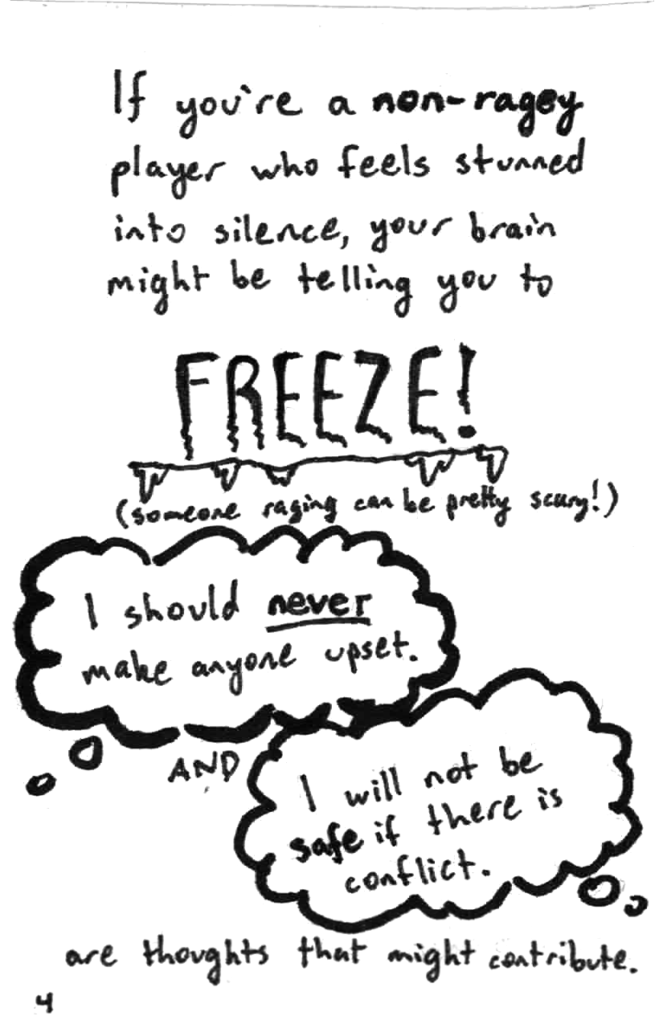
It might seem funny that I’m first addressing the players who aren’t, y’know, flipping tables, but big displays of out-of-control emotion are not the only ways our brains can trip us up. As the sentences in the thought bubbles suggest, it’s possible for bothersome thoughts, unhealed wounds, or unfinished business from the past to affect us in the other way: causing us to shut down at times we’d like to feel active and engaged. By no means am I suggesting that anyone who stands quietly while witnessing another’s aggression must be carrying baggage—just that it could be a possibility.
I work a lot with people who have burnt themselves out by always putting themselves last. That kind of damage doesn’t always draw attention in our culture, because we tend to applaud ‘selflessness’ (especially among people socialized into female gender roles). Again, there’s nothing categorically wrong with avoiding some conflicts, but if you’re strenuously avoiding any possible disagreement to the point where it’s getting in the way of a fulfilling life… well, that sounds like it might be a problem for you. Everyone in your game group matters—including you.
Page 5: Some Ideas If You Freeze
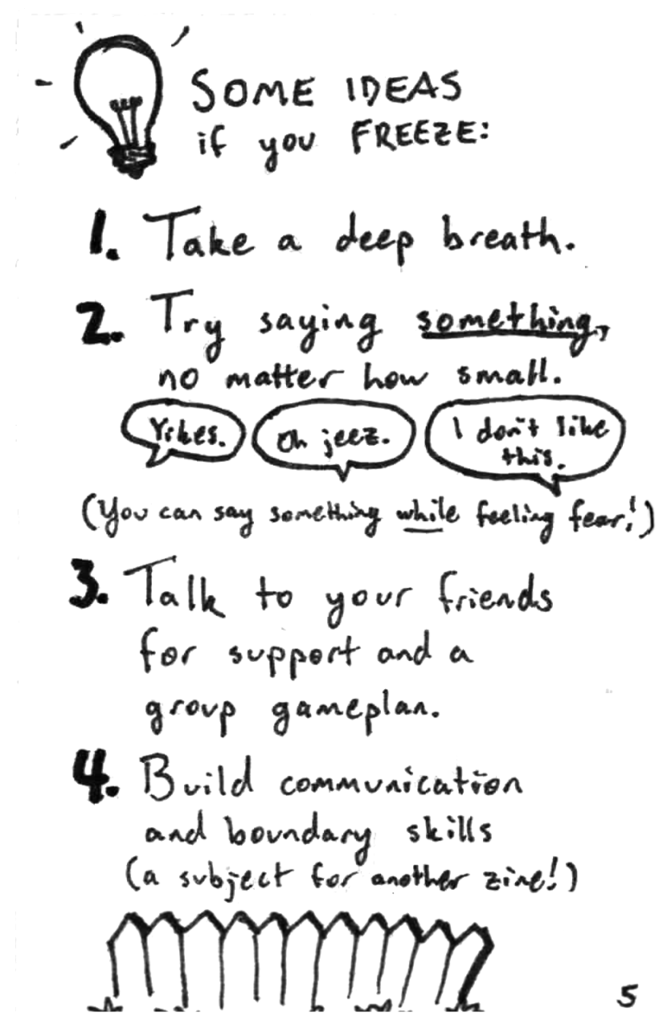
The first point here is “take a deep breath”. I know it’s easy to dismiss this, because who hasn’t been told a thousand times to “just breathe”? But hang with me. There is very little like deep breathing for regulating the nervous system. Breathing deep into your belly activates the parasympathetic nervous system, which helps send the ‘all clear’ to your brain and body and bring you back to a calm baseline. While you’re here, why not try it? Even if you’re not feeling particularly activated at the moment, take a nice deep breath and see if you can notice how your body feels afterward.
Idea #2 is to “try saying something“. When we get emotionally activated, our minds can produce all sorts of thoughts to trap us. You might, for instance, find yourself thinking, “There’s nothing I can say! I can’t say anything!”
This idea is designed specifically to break the stranglehold that we can grant thoughts like that. Thoughts like that don’t have to be true, and the simplest, most straightforward way to deal with them is not by duking it out in a cognitive battle of Truthiness, where you present to your brain all the reasons why, actually, you can say words—it’s just to do the dang thing. Brain’s telling you “I can’t say anything!”? Open your mouth and make a noise. Shows you how much your brain knows.
With time, you can build upward from that tiny utterance. But if you want to be able to speak up in high-tension moments, start with just saying anything. You’ll get there.
Idea #4, “build communication and boundary skills,” is like the understatement of the century, I know. Whole books—real ones, not just mini-zines—have been written on the subject. But a few quick ideas to start your journey:
- Practice using “I” statements: An “I” statement is a neutral, assertive way to inform someone how their actions are affecting you. They look something like this: “When you [did X thing], I felt [Y feeling].”
- Identify your own boundaries: If you had it your way, how would you like to be treated? How do you not want to be treated? While we can’t guarantee these will be met, nobody has better insight into your wants than you—identifying them equips you to work toward them.
This in particular is an area where I love to help people. If you want to build assertiveness, boundaries, and social skills, get in touch.
Oh, and that drawing at the bottom is a white picket fence, because boundaries. I don’t know if that came across.
Page 6: “If you are the rager…”
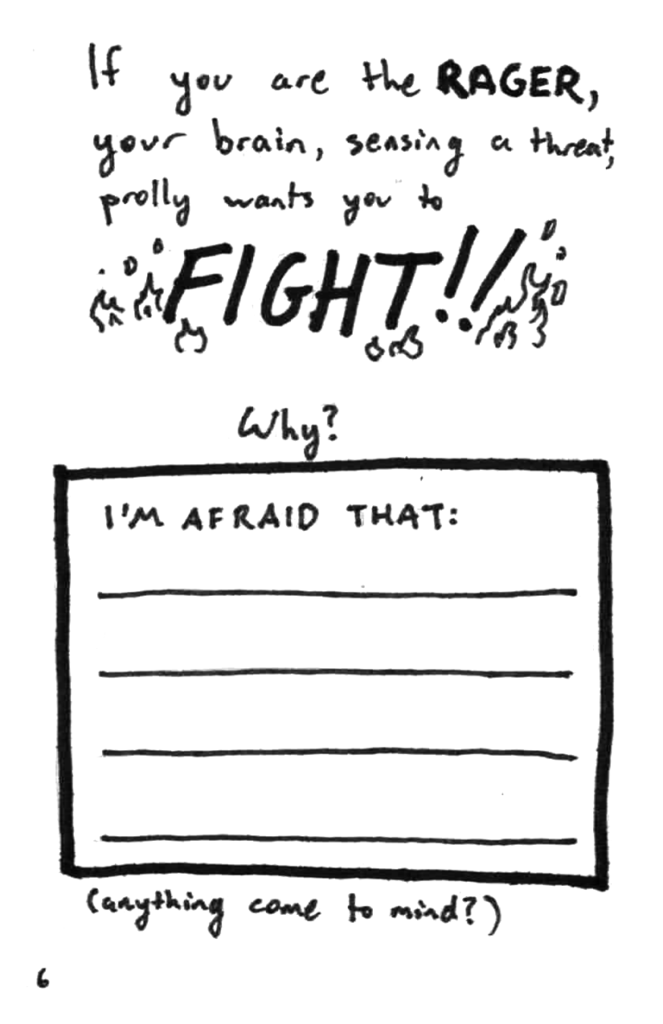
Remember how we said that the amygdala responds to perceived threats with fight, flight, freeze, or fawn? This means that we can work backward: when we notice we’re in one of those modes, we can reflect on what was causing our amygdala to feel threatened.
This can be helpful because it might otherwise be tempting to dismiss the root cause. “I just don’t like losing” is an excuse that won’t get you any closer to change. “I know, it’s stupid of me” might sound apologetic, but it doesn’t help you change either. Dismissive thoughts that don’t help you find the root issue are likely to leave you stuck in the same pattern, possibly getting even more frustrated with yourself.
That’s why this page prompts you to reflect: even though your aggressive behavior isn’t helping you, it likely has its own internal logic. It probably makes sense—from a certain angle. As you come to understand what purpose it’s serving, you can more deliberately work to change it.
Again, that kind of work is probably much bigger than what a zine can guide you through, but this is a starting point. If you really want to dig into anger, a mental health professional can be a great companion in that work. I happen to know one.
Page 7: Some Ideas If You Fight
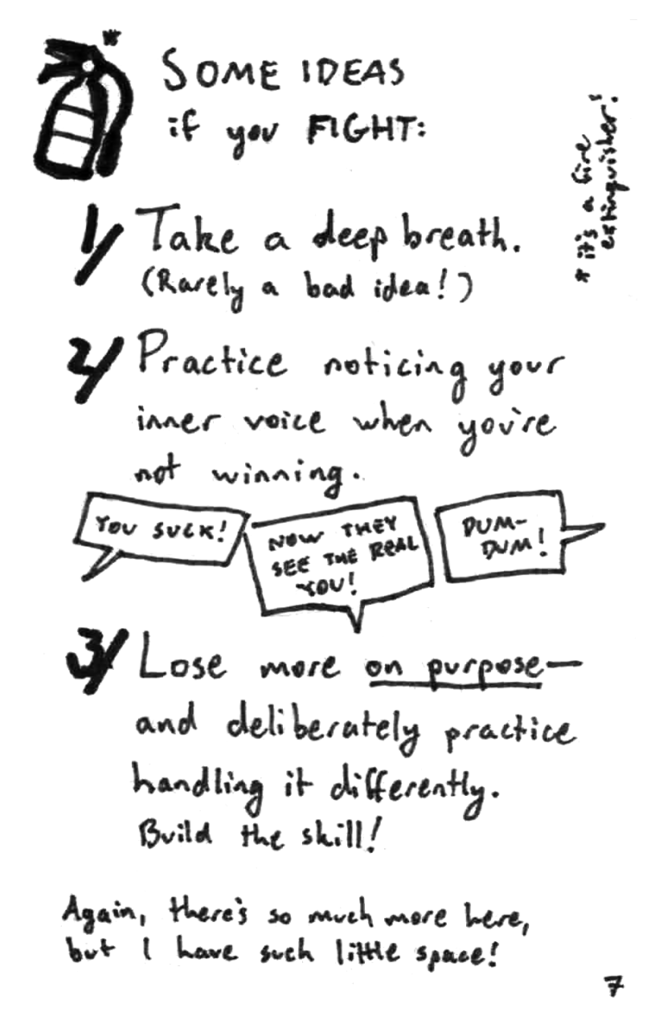
Item #3 on this list warrants a bit more explanation. As a counselor, I believe all behavior is (a) learned, and (b) purposeful. That means that even unhelpful patterns of behavior show up within us in order to meet a certain need or objective, and—good news—we can change them.
If you want to get better at losing gracefully, or any other situation that triggers your fight response, you’re not going to get that practice by continuing to avoid the situation. Put yourself in places where you’re going to lose, and set mini-goals for yourself. Maybe this time, when you feel your blood pressure rising, you’ll take three deep breaths. Another time, you might practice complimenting other players on their skillful plays. Figure out how it is you want to act, and practice that, again and again. Get your reps in.
Closing
Once more for good measure: If you want professional help with anything discussed in this zine, contact a therapist or other mental health worker! If you’re in the Salem, Oregon area, I’d be happy to hear from you, but you can also find a counselor using other methods, like calling your insurance to find in-network providers, or browsing therapist directories like Psychology Today and Being Seen.
Thanks for reading, and I’ll see you in the next one!