

In his book How to Fall in Love with the Future, author and climate activist Rob Hopkins identifies a paradox. We are more aware than ever of the realities of climate change. We see it happening. We not only know that our activities–burning fossil fuels–cause it, we know that this has been known by the U.S. oil and gas industry “since at least the 1950s“. And we know how this is likely to upend life on every corner of the globe. We know.
But confusingly, Hopkins points out, in the face of this overwhelming evidence of impending catastrophe, we’re not, on the whole, acting how you might expect. Of course, some courageous activists are tirelessly fighting to steer us away from disaster, but the majority of us–this humble therapist included–are not acting with any sort of urgency. We’re dormant. We recognize the problem and know it needs action, and yet…
This dilemma–being acutely aware of a problem, one that has already cost us so much and is very clearly on a one-way road to Disasterville, and yet finding ourselves unable to break out of our paralysis–that doesn’t just show up in climate activism, does it? It’s not even limited to the broad field of social change. When I look at those as symptoms, I see a pattern that shows up across a range of mental health diagnoses… most notably, ADHD.
What could this tell us?
Executive Functioning
When we identify a goal–completing a homework assignment, cooking dinner, building a birdhouse–our brains’ executive functions are the processes that help us get it done. There are a lot of these processes, and they include things like switching between tasks, resisting distraction, and holding important information in our memory. For an excellent overview of executive functioning and ADHD, check out this 4-minute video from Jessica McCabe of How to ADHD:
When these functions become impaired, it becomes so much harder to see tasks through to completion. With weaker response inhibition–that’s our ability to resist shiny distractions–we might find ourselves running down rabbit holes instead of staying on track. If our working memory can’t hold as much as our neurotypical peers, or for as long, we’ll find ourselves constantly re-checking the information we need, unable to sustain focused mental work.
Critically, as Dr. Russell Barkley, an expert in ADHD, emphasizes, this is not a knowledge problem. Someone with ADHD who’s struggled for months to paint their brand-new set of Warhammer minis does not need more information about how to paint. It’s also very rarely an effort problem; if effort was all it took to get the thing done, people with ADHD would be ticking off to-do boxes left and right. Understanding disorders like ADHD as executive functioning impairments asks us to think about solutions in terms of strategies, accommodations, and practice–not scorn, shame, or lectures.
Too-Distant Futures
Back in 2020, in the early stages of the COVID-19 pandemic, I observed that the nature of the disease made the valid, evidence-supported precautionary measures feel extreme, and the risks of the disease intangible. Since it could take two weeks after exposure for symptoms to emerge, for many of us, linking the outcome with our actions was an intellectual exercise, not a connection we felt.
When I grab a hot cast-iron pan with my bare hand, the outcome is immediate and the cause and effect unambiguous. I learn from that without even meaning to. When I fail to check that the laundry is fully dry, and notice a musty smell in my closet later that week, the connection isn’t hard to make either. But the two-week dormancy period for COVID-19 strained the capacity of many of us to feel cause and effect. “Right now” and “tomorrow” feel real; “two weeks from now” is a concept.
What I was observing was what ADHD researcher Ari Tuckman calls the “time horizon”. It sounds like something you’d navigate with a TARDIS, or melt a professor of moral philosophy’s mind with, but the actual meaning is a little more mundane. If you imagine that you’re standing on a timeline, staring forward into the future, the time horizon is the point where the line bends out of sight. We can talk about what exists beyond the time horizon, we can imagine it, but it’s “out there”, distant and unperceived. Everything beyond the time horizon feels equally intangible–you can probably sense the difference between 5 minutes and 5 days, but 500 and 5,000 years are just both “a long time in the future”. The distinction is intellectual.
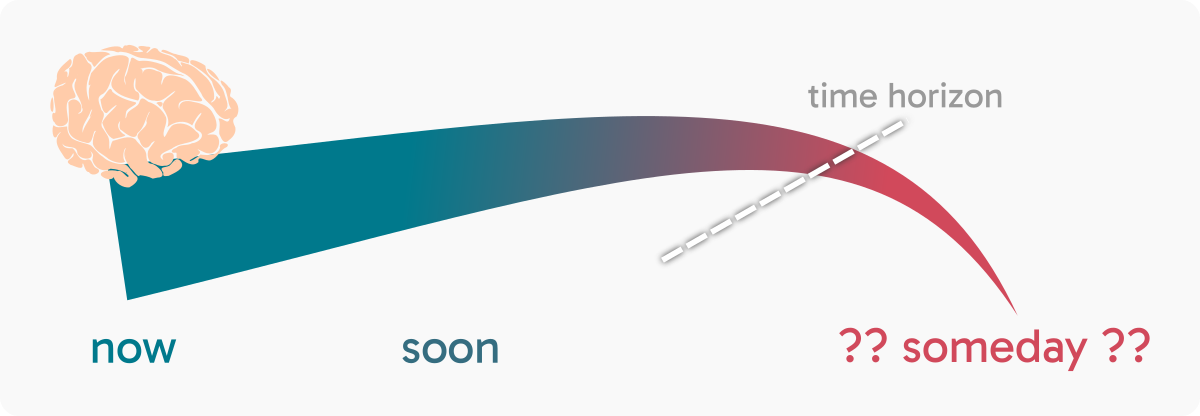
People with ADHD tend to have much shorter time horizons than those without–a difference in executive functioning. Whereas a neurotypical person may be able to see events coming from a week away, for someone with ADHD, it might only be a day or two. And thanks to another psychological effect called temporal discounting, where the further away a consequence is, the less we feel it now, even catastrophic consequences just won’t feel real if they’re on the other side of our time horizon.
In Stolen Focus, an exploration of the fragmentation of our collective attention, journalist Johann Hari deftly points out the relationship between attention and the massive political, social, and environmental crises facing our planet. “Solving big problems,” he writes, “requires the sustained focus of many people over many years.” To observe our surroundings and our homes; to listen to them, ourselves, and each other; to hold a vision of the future in our minds long enough to bend the arc of our story toward it–these all take attention and care. Even if diagnostic labels like ADHD don’t apply to you, if you participate in our modern attention economy, you may very well find that the practice of sustained focus is harder than you want it to be.
Clearly, this is a problem! It’s a problem for our collective action, and it’s a problem for our individual lives. Personally and collectively, we face problems that require sustained effort, yet if we wait for the sense of urgency that comes when an issue pops over our time horizon and into our present awareness, we will be far too late.
Traveling Beyond the Horizon
Ari Tuckman calls it “feeling the future”. For Rob Hopkins, it’s “time travel”. But despite coming from two very different backgrounds, I think these two are describing the same thing.
To motivate ourselves to work toward a distant future, few of us need more information. When we can’t muster the executive functioning to make change, it helps us to have a vision. As Hopkins points out, research shows that imagination and recalling memories look very similar in our brains, and vivid imagining can shape our emotions and our behaviors. Without any extra effort, future events that are beyond our time horizon will be subject to temporal discounting and will feel unreal, but we can hack that with our imaginations.
Too often, when we’re mired and stuck in our minds, whether due to something like depression or ADHD, or because we’re facing seemingly impossible, globe-spanning problems, the best future we can muster is “not this.” Where do I want to be? Not feeling paralyzed by this silly birdhouse project. Not watching summers get hotter and drier each year. And as an expression of anguish, valid! Of course you don’t want to be here when here sucks. But those visions aren’t encouraging or activating. You wouldn’t fall in love with someone whose best trait was “not a jerk”—why would you expect to fall in love with milquetoast futures like that?
So Tuckman and Hopkins recommend practices of rich imagining. Bring in all your senses: what would you see, in the future where it went right? What would you hear? Smell? How would you move your body? Hopkins, in his activism work, goes even further, encouraging participants in his workshops to collect items that make their futures tangible–foraging materials that create a smell of the future scene, for instance, or getting crafty and using collage to bring the future into vision. The more details you add, and the more you allow your mind to experience and inhabit the scenes, the more you pull that image over the time horizon and into a present where you can actually engage with it.
Sometimes, the mere act of exploring that imaginary future will prompt our brains to start problem-solving in new ways. Other times, keeping the rich future nearby can be motivation itself. Love and dedication are powerful motivating forces. And if you share your dreams with others who care about you, communal support might help provide you with extra oomph in those places where you can’t quite make it all on your own.
But critically, using your imagination like this isn’t idle daydreaming. It’s the purposeful work of finding futures that you yearn for–so when you come back to the present, you are ready to take action.